Most New York bars that advertise a private room are offering one of four things: a fully enclosed room, a glass-walled semi-private room, a stanchioned section of the main floor, or a large table in an alcove. All four can work. The trick is knowing which one you are actually booking before you commit any money, because the word “private” is doing a lot of quiet work in those listings.
Search for a bar with a private room in Manhattan and you get a few hundred results in two seconds. Almost none of them tell you what the room actually is. You find that out on the walkthrough, or worse, on the night, when your thirty guests discover that the “private room” is a corner of the bar with a rope across it and a speaker six feet away.
We run event spaces at a gin bar on East 14th Street, so we have both hosted these parties and met people who arrived having booked the wrong thing somewhere else. This is the breakdown we wish every venue listing gave you.
The Four Things a Bar Means When It Says “Private Room”
There is no industry standard here, which is exactly the problem. In practice, New York bars use the phrase to describe four different products.
- A fully enclosed room. Solid walls, a door, its own sound. Rare in bars below a serious minimum spend in Manhattan, and more often found in restaurants.
- A glass-walled or partitioned room. A real, separate room with sliding or fixed glass, so the space reads as its own but still feels connected to the bar. This is the most common true private room in a bar setting.
- A stanchioned section. Part of the main floor, roped or barriered off, reserved exclusively for your group. Private in the sense that nobody else sits there. Not private in the sense of sound.
- A reserved large table or alcove. A communal table or cut-out nook held under your name. Fine for ten people and a birthday, but it is a table, not a room.
None of these is wrong. A stanchioned section for fifty at a draft party beats a sealed room for fifty who wanted to mingle. What matters is that you know which one you are getting. It also helps to know how venues price these spaces, because the room type and the pricing model are usually linked, and we broke that down in our guide to minimum spend versus room fee.
What a Real Private Room Has That a Roped-Off Corner Does Not
When you walk a space, four details tell you almost everything. Ask about all four, in this order.
Sound separation. Can you hear the main bar’s music at conversation volume? If the answer is yes and your event involves a speech or a toast, you need a different space or a different plan. Glass helps more than people expect. An open floor plan does not.
A defined boundary. Walls, glass, or stanchions. Without one of those three, other guests will wander in. Every venue will tell you this does not happen. It happens.
Somewhere to put coats and bags. Most New York bars have no coat check. A room with bench storage underneath, or a wall of hooks and pegs, is the difference between guests relaxing and guests sitting on their own jackets for four hours.
Its own service. Ask whether a server is assigned to the space or whether guests order at the main bar. Both work, but they produce very different nights, and very different tabs.

Match the Headcount to the Space, Not the Other Way Around
The most common booking mistake in this city is picking a room you like and then trying to fit the guest list into it. Do it backwards. Here is the mapping that holds across most Manhattan bar venues, using our own spaces as the worked example.
| Guests | Space type | What it suits |
|---|---|---|
| Up to 10 seated, 12 to 15 standing | Alcove or communal table | Dinners, small birthdays, a home base for a night that moves |
| Up to 20 seated | Semi-private room with glass walls | Showers, milestone birthdays, team dinners, anything with a toast |
| Up to 20 seated | Reserved lower-seating section | Longer sit-down gatherings where comfort beats mingling |
| Up to 55 standing | Stanchioned section of the main bar | Draft parties, large mixers, anything where people move around |
Notice that seated and standing capacity are not the same number, and the gap can be large. Ask any venue for both before you book.
The Questions That Separate a Good Booking From a Bad One
Ask these before you commit. Any venue worth booking will answer all of them in one email.
- Is this space enclosed, partitioned, or stanchioned?
- Is there a rental fee, a minimum spend, or both?
- Can guests run separate checks, or is everything on one tab?
- What are the decoration rules, and what is banned?
- Is the kitchen open for the whole booking, or does it close mid-event?
- What happens to the reservation if my headcount drops by a third?
The decoration question catches people out constantly. Most venues have rules and most do not publish them. Ours are simple: nothing taped to the wallpaper in the back room, and no glitter or confetti anywhere, because neither ever fully leaves a bar floor. Balloons, banners, signs and unflattering photographs of the guest of honour are all welcome. If you are working at the smaller end, our guide to private parties of ten covers that scale in more detail.
What Private Rooms Look Like at The Winslow
We are a British-style gin bar and eatery at 243 East 14th Street, on the line between the East Village and Gramercy.
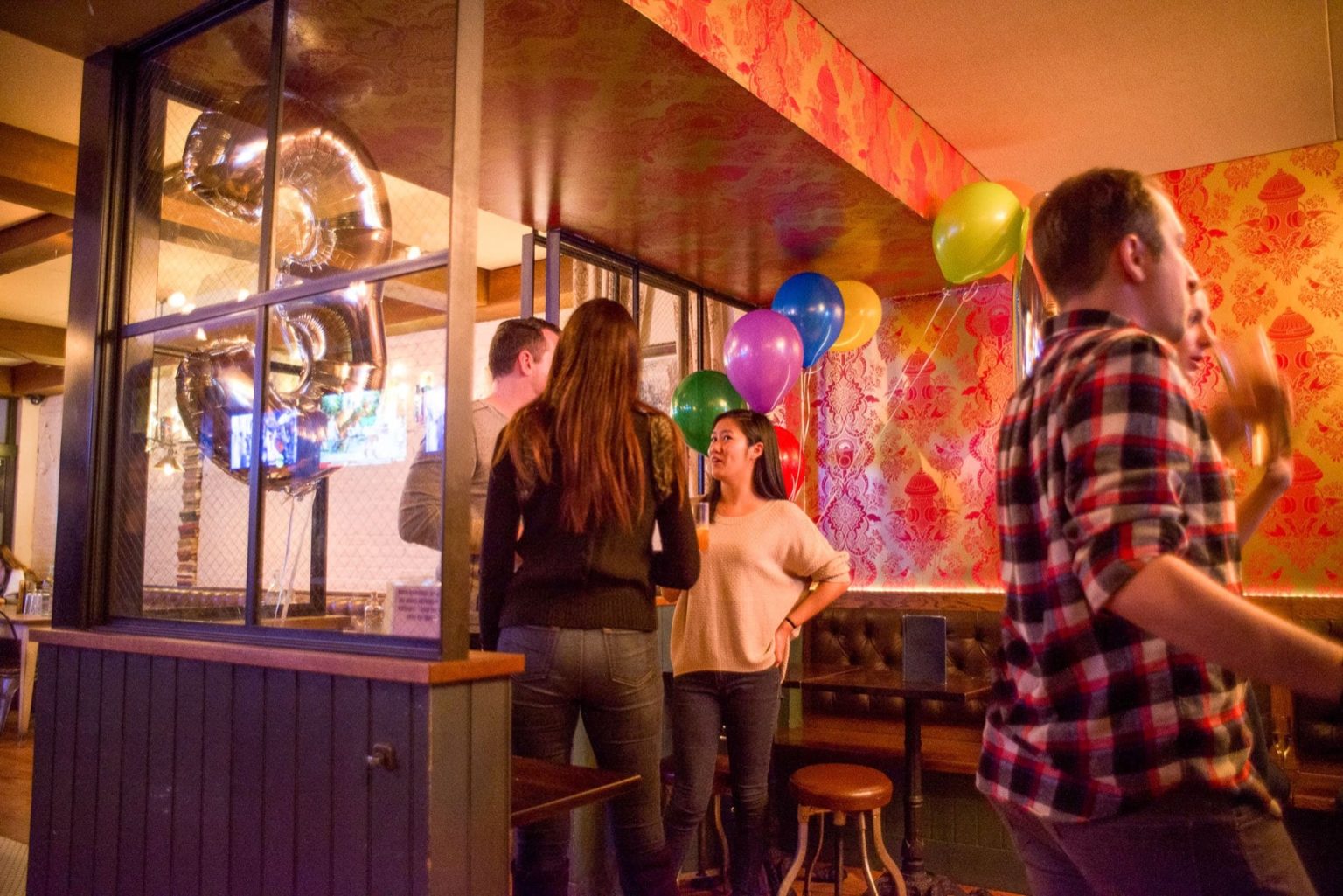
Our back room is the glass-walled kind. Two window walls with sliding doors, so the group reads as its own party without feeling shut away from the bar. It seats twenty. The benches have storage underneath for coats and bags, and two of the walls are covered in Flavor Paper wallpaper that hides golden pigeons, rats and fire hydrants in the pattern. Guests find them roughly forty minutes in, usually by accident.
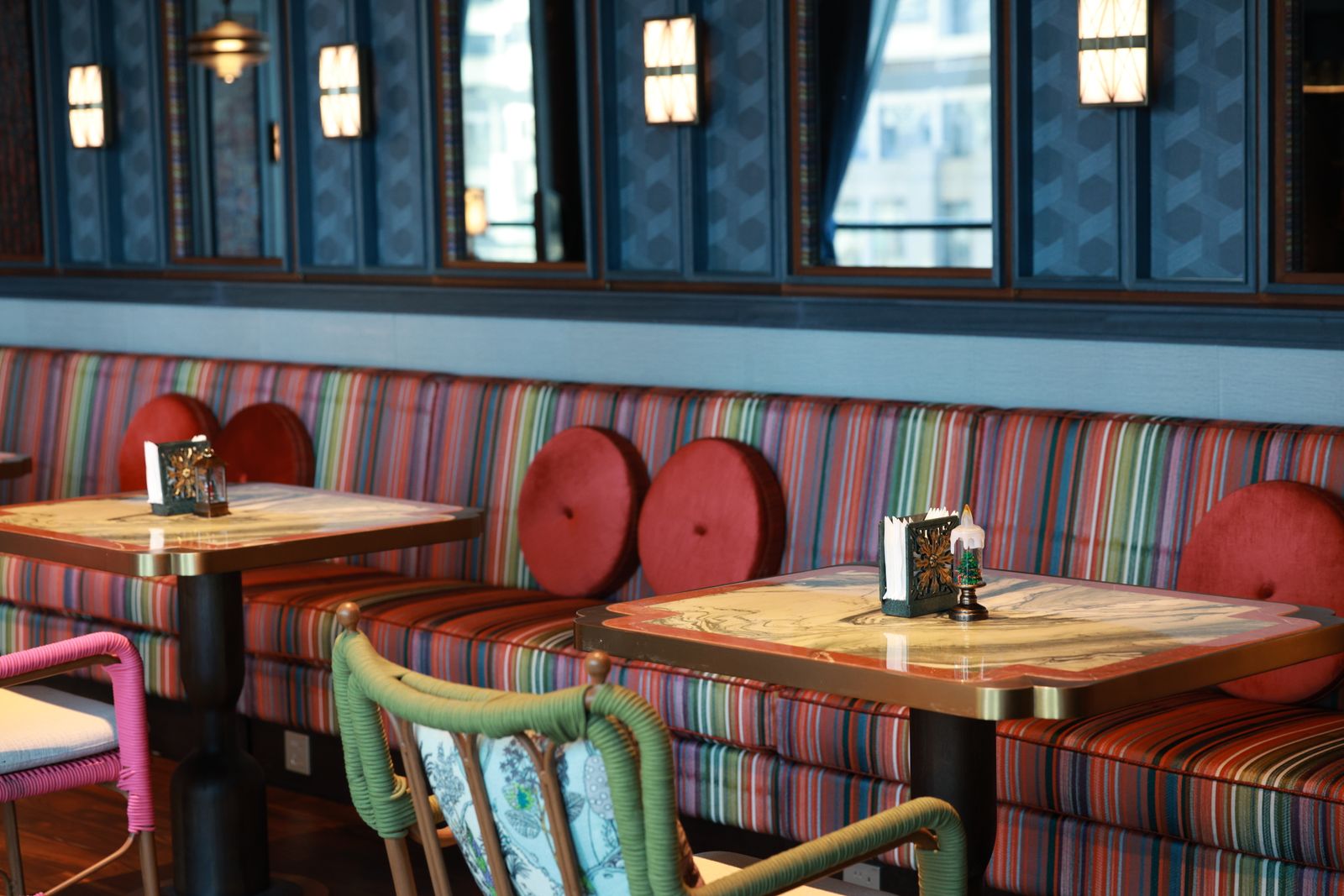
Beyond that we run three semi-private options. The Communal High Top area is the right half of the main bar and holds up to fifty-five when it is stanchioned off and the pillar tables are pulled out. The Banquette section is the entire left half, seating twenty in lower and more comfortable seating. The Nook is a communal table in an alcove across from the bar, seating ten. Full capacities and layouts sit on our bar with private room page.
There are no rental fees of any kind on any of them. There is a minimum spend, we tell you the number before you commit, and we run separate checks.
Where This Leaves You
The short version: stop searching for “private room” and start searching for the specific thing you need. Enclosed if there is a speech. Glass-walled if you want separation without isolation. Stanchioned if people will be standing. A table if there are ten of you.
Then ask the six questions above, get the answers in writing, and book the space that was built for your headcount rather than the one with the best photograph. If you are still comparing venue types, our guide to finding private event spaces in New York City covers hotels, restaurants and dedicated venues too, and if you are weighing a full buyout, read what it really costs to rent a bar for a party first. If a work crowd is involved, our notes on planning a corporate happy hour and on throwing a work holiday party both cover the parts that go wrong after the room is booked.
Frequently Asked Questions
What is the difference between a private room and a semi-private room in a NYC bar?
A private room is fully enclosed with solid walls and a door, so sound and sightlines are separated from the main bar. A semi-private room is partitioned, usually with glass or a half wall, so your group has its own defined space while staying visually connected to the room. Semi-private is far more common in bars, and for most parties it is the better experience.
Do NYC bars charge a fee for a private room?
It depends on the venue and the model it uses. Some charge a flat room fee, some set a minimum spend on food and drink with no separate fee, and some charge both. At The Winslow there are no rental fees of any kind, only a minimum spend that we quote before you commit.
How many people fit in a bar private room in New York City?
Most true private and semi-private rooms in Manhattan bars hold somewhere between fifteen and forty guests. Our back room seats twenty, and our stanchioned Communal High Top area takes up to fifty-five standing for larger groups.
Can you reserve a private room at a bar for free?
You can reserve without paying a rental fee at venues that use a minimum spend model, which is what we do. You are still committing to a food and beverage total, so it is not free in the sense of no obligation, but no money disappears into a room charge.
How far in advance should I book a private room in NYC?
For a weeknight group of twenty, two to three weeks is usually enough. For a Friday or Saturday night, or for anything in December, give yourself six to eight weeks. Holiday season books out first and fastest in Manhattan.
Can we decorate a private room at a bar?
At most venues yes, within limits, and the limits are rarely published so you have to ask. Ours are that nothing gets taped to the back room wallpaper and no glitter or confetti is used anywhere. Balloons, banners and signs are all fine.
Book a Room That Fits Your Night
Tell us your headcount and how the evening runs, and we will tell you which of our four spaces is right for it, along with the minimum spend before you commit to anything. Send the details through our event request form, reach the team on our contact page, or call us at (212) 777-7717.